
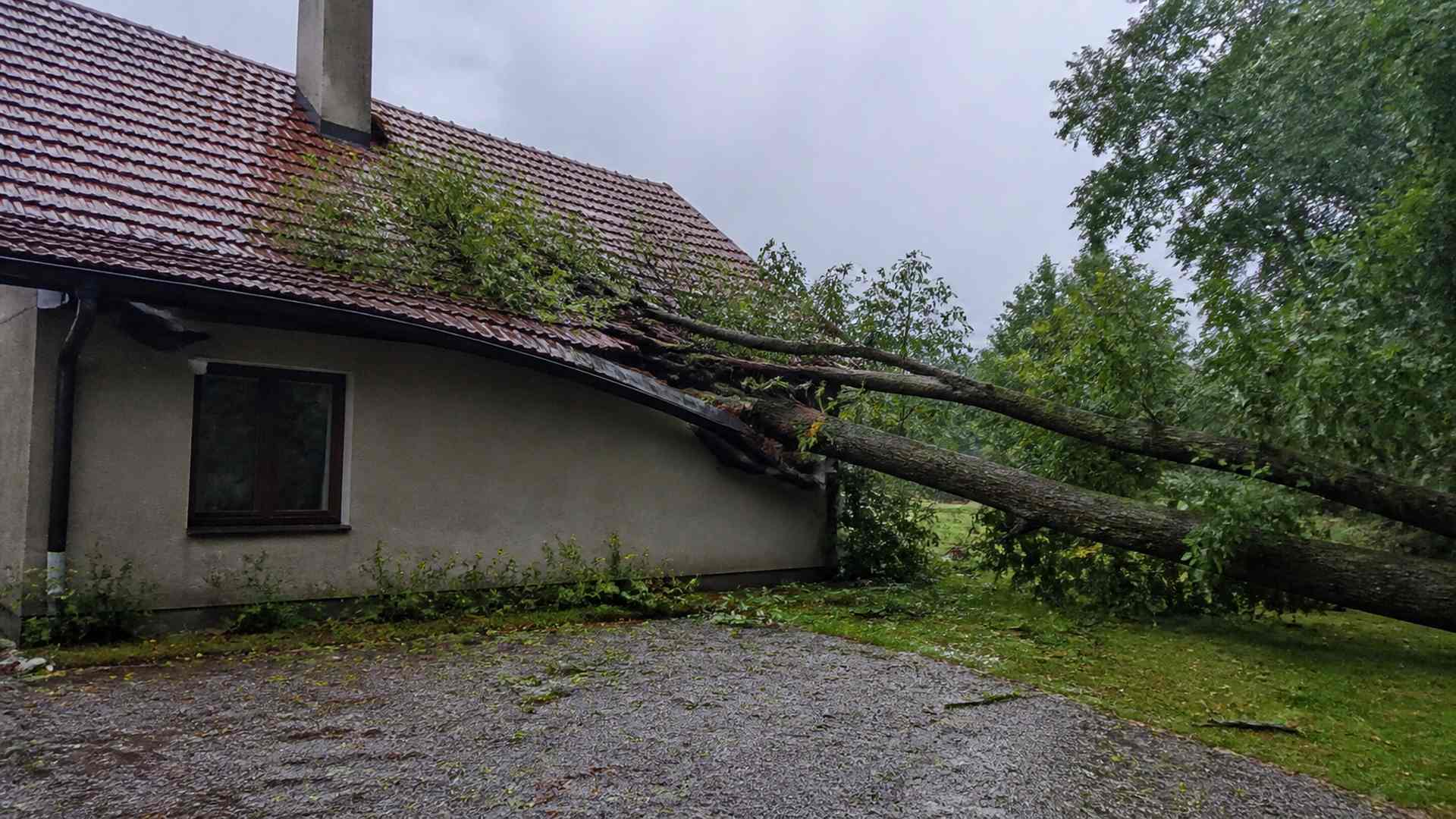
1. Is anyone in danger
The first question is not about the roof, it is about people. Check that everyone in the house is unhurt and that nobody is in the room the tree has come into.
If the roof structure is damaged — ceilings sagging, rafters cracked, a crack visible in a wall, doors or windows no longer closing — get out of that part of the house and do not go back in for belongings. A tree lying on a roof is not stationary. It is resting on a damaged structure, and that structure carries on settling. In a gust of wind, or a few hours later, the tree can slip and go in further.
If the house has gas heating or a gas hob and you can smell gas, turn off the supply and go outside.
If the fallen tree is touching an electricity line or a service cable, or is close to one, treat everything around it as live — the tree itself, the wire fence and the ground around it included. Conductors can be live even if they look undamaged and nothing is arcing. Do not go near, and do not try to pull anything off. Contact the electricity network operator's emergency service first and wait for the line to be isolated. No tree work begins there before that. We work once the operator gives permission — more on this: tree removal near power lines.
2. Do not climb on the roof and do not try to move the tree
This is where most accidents happen after a storm — not during the storm itself, but the next day, when people start clearing up.
A fallen tree is under tension. It is bent, the branches are compressed under the weight, and part of the tree's weight is bearing on the roof while part rests on the stump or the ground. When such a tree is cut in the wrong place, the stored tension releases all at once: the trunk springs back, twists about its own axis, or rolls. It happens faster than a person can step away. A chainsaw in that situation is more dangerous than the tree.
Nor should you climb onto the roof to see how bad it is. The roof covering under the tree is broken, and what looks sound may be nothing but sheet metal with no support beneath it. The damage can be assessed from the ground and from the loft.
- Do not take off branches that are holding the tree in place — often they are the only thing keeping it there.
- Do not pull the tree with a car, a winch or a tractor. Dragging it across the roof tears out the covering that is still intact and can pull the rafters out with it.
- Do not let children or animals into the garden until the tree has been removed.
3. Photograph everything before anything is moved
This is the one step that cannot be put right afterwards. Once the tree has been taken off, the scene cannot be recreated, and your insurer sees only a damaged roof with no context. Take the photographs while everything is still as it was left.
- The whole scene from a distance — so that the house and the tree are in one frame together.
- The tree on the roof from several directions.
- The specific damage close up: the hole in the covering, broken rafters, cracks in the wall, guttering pushed out of place.
- Damage from inside — ceilings, the loft, soaked walls, belongings that have been flooded.
- Where the tree came from: the stump or the lifted root plate, and whose property it stands on. This shot is what later settles the question of liability.
- If you can, the date and time as well — a phone saves these automatically, so do not take the pictures with the time setting switched off.
A video, walking round the house and describing what you see, is every bit as useful as individual shots. Do not throw away any broken pieces until the insurer has inspected the loss.
4. Notify your insurer
Contact your insurer as quickly as you can and tell them what has happened. Storm damage is usually one of the most common claims on a household policy, and the procedure is set by the terms of your policy specifically — so find it out from them, not from the neighbours.
Two things that normally apply to everyone:
- Limiting the loss is normally expected. Most policies expect the owner to take reasonable steps to stop the damage getting worse — covering an opening so the rain does not come in, for instance. You may do that, if it can be done safely.
- Repairs generally must not be started before the loss is inspected. Covering something temporarily is not a repair. Rebuilding the roof is. Before you replace the covering or the rafters, clear it with your insurer.
Keep all the paperwork for any work carried out to make the situation safe. If we come out to make the site safe, you receive documentation for it.
5. Limit the water damage from inside
After a storm, most of the further loss comes not from the tree but from the rain coming in through the opening. If it can be done safely and without getting onto the roof:
- Switch off the electricity in the part of the house where water is coming in. Water and wiring together are dangerous.
- Move furniture, electronics and documents out of the area beneath the running water.
- Put buckets or containers under the leak and cover the floor.
- If water is collecting in the loft above the ceiling, it can bring the whole ceiling panel down at once. Do not forget to look in the loft.
- Do not climb onto the roof with a sheet of plastic in the wind. Covering from outside is a job for after the tree has been removed, and not during a storm.
6. Warn the neighbours
If the tree has come down only partly and the other half is still hanging over a neighbour's fence, garden or car, tell them. The same applies to a second tree that this one has bent or part-broken on its way down — after a storm it often happens that one tree leaves another half-broken, and that one comes down later, in calm weather. If the danger zone extends across the boundary, a warning is both courtesy and in your own interest.
How we work when we arrive
The first aim is not to clear everything away. The first aim is to make the site safe. Those are not always the same thing.
We work out how the tree is bearing
Before a saw is started we establish where the tension is, what the tree is resting on, and what will happen as each bearing point is removed. This is the longest and the most important stage.
We take the weight off in the right order
We cut the crown and branches away in sections, starting from the tips, so that the weight on the roof comes off gradually. Sections of trunk lying on the building are rigged with ropes and lifted off rather than dropped.
We do not drag anything across the roof
The tree is lifted off, not pulled sideways. In difficult cases we use a MEWP or a crane, because that allows the pieces to be taken off vertically.
We finish with whatever is still hanging
Branches that are broken but have not fallen are the most dangerous part of the whole situation, because there is no telling when they will come down. We take those off too, even if they are not on the roof.
We clear up
We chip the branches and take them away, and we cut the trunk up. We take the wood chip and branches away rather than leaving them in your garden. If you want to keep the firewood, we cut it to length and stack it there.
Sometimes the right answer is two visits: on the first we remove the risk, and on the second — once the roof has been inspected and the repair has been planned — we finish the clear-up. If that is the more sensible way round, we say so. More on how this kind of work is done: emergency tree removal and tree removal over roofs.
Whose tree it was, and what that means
This question comes up almost every time, and there is no single answer to it.
If the tree was yours, it is a matter for your household insurance. If the tree belonged to a neighbour or to the local authority, it is not automatically their liability simply because the tree grew on their land. In practice what usually decides it is a different question: did the owner know, or ought they to have known, that the tree was dangerous? A healthy tree brought down by a severe storm and an already decayed, dead tree that had been reported are two quite different situations.
That is why the earlier photograph of where the tree came from matters — particularly the shot showing the base of the stump. If the wood inside is dark, soft or decayed, that is visible immediately after the break, but not a week later. We are not lawyers and we do not give categorical opinions, but we are often the first to see that break, and whatever we saw, we tell you.
How these situations usually play out we have described under who is liable for a fallen tree and neighbours' trees and liability. Discuss the specific procedure with your own insurer.
After a big storm: honestly, about waiting
On the day of a storm there are dozens of times more call-outs than on an ordinary day. In an emergency we try to come out the same day, but the realistic time depends on the time of day, the weather and how many enquiries there already are. If we cannot come straight away, we say so, rather than promising and not turning up. If there is something about your situation that makes it more dangerous than others — the tree is moving, there are people living in the house, power lines are involved — put that in your enquiry, and we take it into account in the order of the queue.
Fill in the form on our contact page and attach the same photographs you took for the insurer. From those we can see what equipment will be needed, and we can give you an approximate quote before we even set off.
What the cost depends on
There is no flat price for work like this, because two identical houses with an identical tree on the roof can call for entirely different work. The cost is affected by the size and species of the tree, how heavily it is bearing on the building, whether a MEWP or a crane is needed, what the access is like, how much brash and timber has to be taken away, the time of day and the urgency. We have set the factors out with explanations on our prices page. We tell you the price before the work starts, not after.