
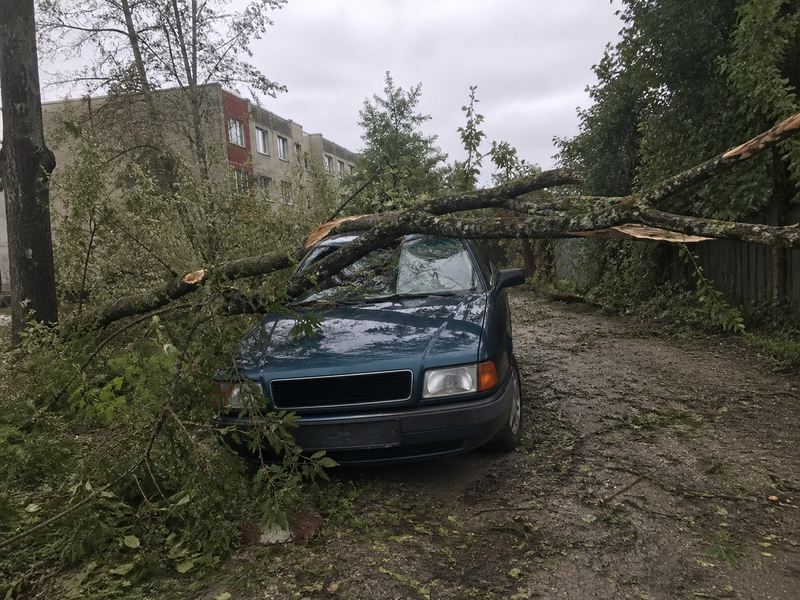
1. First — do not go near it unnecessarily
If the tree is still lying on the car, do not get in and do not sit in the vehicle, not even for a moment to fetch your belongings. The tree is resting on the car unstably — the roof and the glass carry on giving way under the weight, and the tree can slip.
If somebody is still inside the car and cannot get out, this is no longer a tree job — call the emergency services and do not wait.
If the tree has brought down an electricity line as it fell, or cables are lying on the car or on the ground nearby, treat the whole area as live. Do not approach, do not touch the car and do not try to push anything aside. If you are inside the car and the cables are on it, stay inside until the network operator has confirmed that the line has been isolated. Contact the operator's emergency service first — tree work near power lines begins only after that.
If the car is on a road or carriageway and blocking traffic, put the hazard lights on and set out a warning triangle, if that can be done safely without going near the tree.
2. Photograph it before anything moves
With a car this step matters even more than it does with a building. A house stays where it is — the damage can still be inspected a week later. A car gets towed away, and after that it is impossible to prove where it was parked, how the tree was lying on it and where the tree came from. Everything you need has to be captured in those first ten minutes.
- The tree on the car — from several directions, so it can be seen which part of the tree is lying on which part of the car.
- The damage close up: roof, bonnet, glass, mirrors, sides, tyres.
- Where the car was parked — a wide shot showing where the vehicle stood: the parking bay, the roadside, the courtyard, the buildings or signs nearby. If there is a parking permit or a sign, photograph that too.
- The base of the tree and where it grew: the stump, the lifted root plate, or the point of the break. Photograph the broken surface close up — whether the wood is pale and sound, or dark, soft and decayed. This single shot may later prove the most important of all.
- Whose property the tree grew on — a shot showing the base of the tree and the boundary, fence or road edge in the same frame.
- The surroundings generally, and other storm damage nearby, which shows what the conditions were.
A video, walking round and saying aloud what you can see, is a useful addition. Do not try to straighten or clean anything before the photographs. Keep the broken parts.
3. What normally covers the damage
There are two separate routes here, and they are not interchangeable.
| Your comprehensive cover (KASKO) | A claim against the tree's owner | |
|---|---|---|
| What happens | You report the damage to the car to your own insurance company | You claim your losses from whoever owned the tree |
| What it turns on | Your policy cover and whether falling trees are included in it | Whether the owner knew, or ought to have known, that the tree was dangerous |
| How quickly it resolves | Usually faster and more predictable | Usually longer, and the outcome is not known in advance |
| What you need | Photographs, a claim, documentation of the incident | The same photographs, plus evidence of the tree's condition before it fell |
The simple version: damage to the car itself is normally a matter for comprehensive motor insurance (KASKO), and that is the quicker route. A claim against the tree's owner is a separate matter, and it rests not on who owned the tree but on whether the owner knew about the danger. A healthy tree brought down by a storm of exceptional severity, and a tree that had been dead for a year and had been complained about, are judged entirely differently.
We are not lawyers and we will not give you a categorical answer about your case. This is a description of how these situations usually work out — for how it stands in your particular policy, check with your insurer, and do so before you move anything.
4. Whose tree it was
The answer determines who you need to talk to at all, so establish it straight away, while you are still on site.
- A tree growing on your own property. There is nobody to bring a claim against — it comes down to your own policy.
- A neighbour's tree. The question is whether the tree's condition was apparent and whether it had been reported. If you have ever written or spoken about the tree, find that correspondence.
- A tree on local authority land. The local authority has its own procedure for receiving reports and claims about fallen trees. Record the exact location.
- A tree on the roadside. Here the owner is the highway authority, and that depends on the category of road — a city street, a municipal road and a state highway are not the same thing.
If you are not sure whose land is whose, it can be checked in the Land Register and cadastre records. More on how these questions usually resolve: who is liable for a fallen tree and neighbours' trees and liability.
5. The most common mistake: dragging the tree off in a hurry
It happens almost every time. Somebody with a car, a winch or a tractor offers to pull the tree off quickly, because it looks like a simple job. The result is predictable: dragged sideways, the trunk is hauled across the entire bodywork. Branches and broken wood scratch the paintwork, ruin a wing that was still untouched, push out a door frame and break a windscreen that had come through intact. A dent in the roof that could have been repaired turns into replacing whole panels.
A tree is taken off a car upwards, by cutting it into pieces and lifting each piece off separately. Dragging it sideways means the entire weight of the tree scrapes across the bodywork. If somebody offers to “just pull it off”, that is the definition of a different job, not this one.
The same applies to cutting without preparation. A tree on a car is under tension — bent and supported at several points. Cut in the wrong place, the trunk springs back or rolls, and it does so on the car's bodywork.
How we free the car
We check where the tension is
We establish what the tree is bearing on and what will happen as each bearing point is removed. Only then do we start cutting.
We take the branches off first
We cut the branches from the tips inwards, so the weight on the car comes off gradually and the trunk is never left suddenly without support.
We cut the trunk into pieces and lift them off
Each section lying on the car is rigged before it is cut and then lifted off vertically. We drag nothing across the bodywork. If a piece is too heavy, we use a MEWP or a crane.
We give you a chance to photograph it again
Once the tree is off, the damage is fully visible. This is the moment for the second set of photographs for the insurer — before the car is moved.
We clear the site
We chip the branches and take them away, and we cut the trunk up. We take the wood chip and branches away rather than leaving them on site. If the tree is still partly standing, or there are parts broken off but not yet fallen, we remove those too — otherwise the same thing happens again.
If the tree damaged a building as it fell, the order of things there is different — we cover that separately: a tree has fallen on the house. If the tree has not yet come down but is hung up or leaning over the parking area, that is emergency work, and it should not be put off.
After a storm, and what the cost depends on
On the day of a storm there are a great many call-outs. We try to come out the same day, but we tell you the realistic time when we reply to your enquiry — it depends on the time of day, the weather and the number of enquiries. If we cannot come straight away, we say so honestly.
The cost is affected by the size of the tree, how heavily it is bearing on the car, whether a platform is needed, what the access is like and how much timber has to be taken away. We have set the list of factors out on our prices page. Fill in the form — we get back to you within 5 minutes, talk through what the job will involve, and give you an approximate quote in advance.