
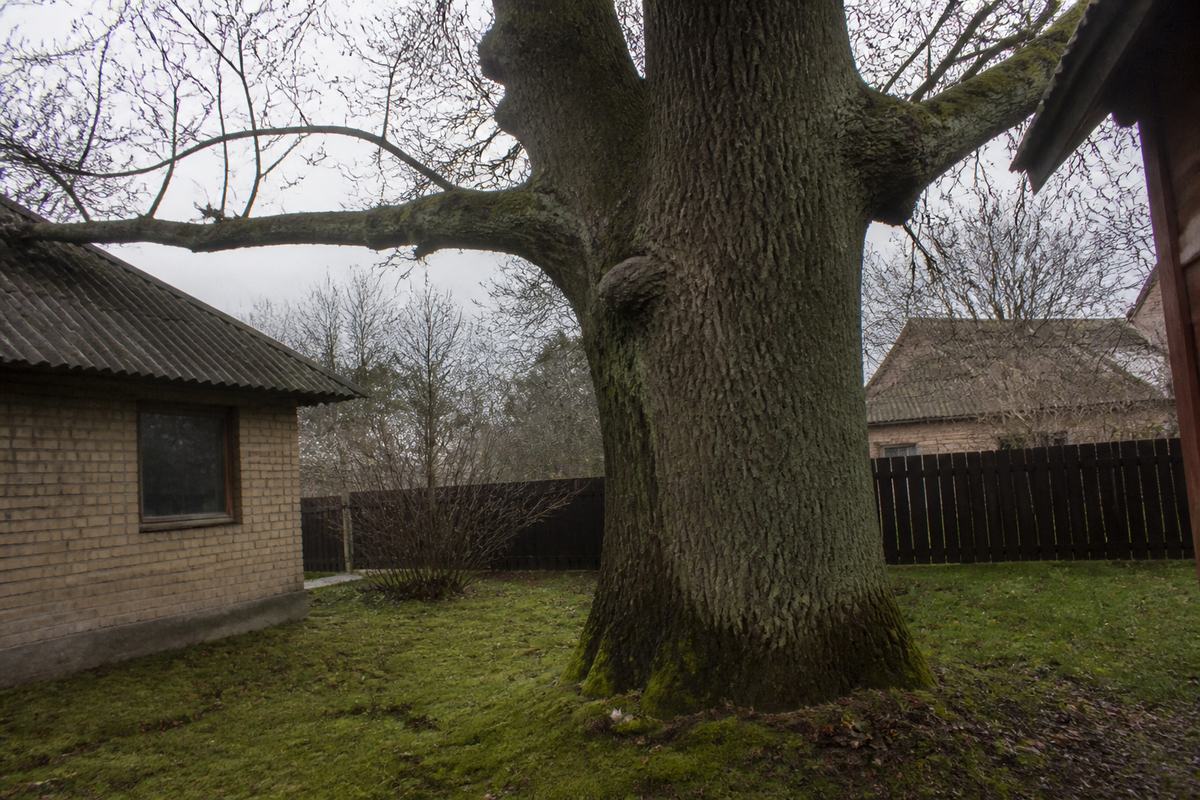
Ikšķile is a residential suburb with a strong garden culture: there are old houses with mature oaks and limes, and new quarters where the trees have only just reached their first serious size. And there is the bank of the Daugava, which is a category of work all its own.
The Daugava bank and the slopes
In the bank zone of Ikšķile and along the edge of the reservoir the trees grow on slopes and in wetter ground. The willows, aspens, black alders and birches growing there grow fast but are brittle, and they are the first to break after storms.
On a slope a tree is often leaning, and there is tension in the trunk — which means the order of cuts is not a free choice: a wrong cut can make the trunk jump suddenly. How to tell an established lean from a new one and what to do about it is described under leaning trees.
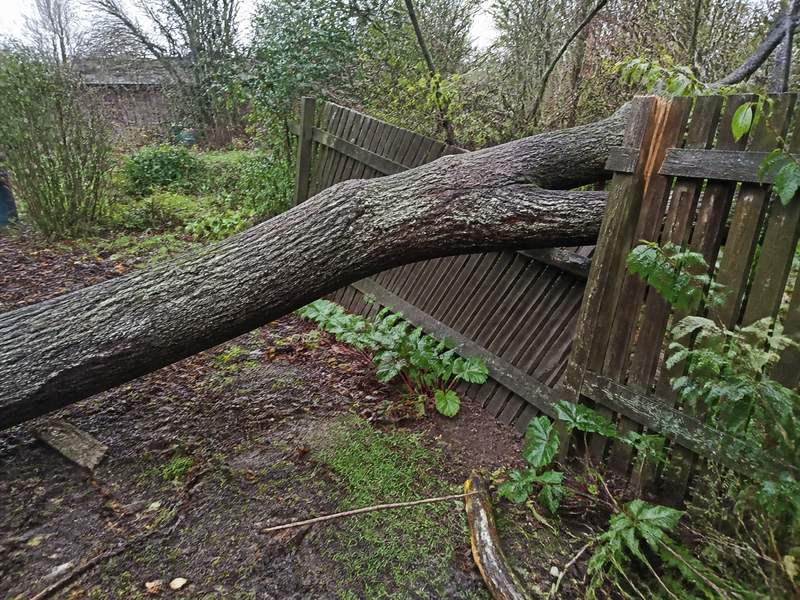
Mature garden trees
In the older parts of Ikšķile many gardens have fully grown oaks, limes, maples and birches planted a generation of owners ago. They are an asset to the property, and the first thought is usually not the right one.
In most cases the answer is care rather than removal: deadwood removal, reducing the weight of the crown and keeping an eye on it. If the garden also has old apple and pear trees, they have their own rules and their own right time — fruit tree pruning.
New development and confined spaces
In the newer Ikšķile quarters the plots are smaller, the houses closer together, and a tree often grows right between two buildings or on the boundary. There is no drop zone there at all.
On sites like these we work between buildings and in confined spaces, lowering every section on a rope. If the branches reach over the neighbour's boundary, it is worth talking it through with them before the work — we have written about the legal side under neighbours' trees and liability.
Access on the A6 and by rail
The A6 and the electrified railway connect Ikšķile with Rīga, Salaspils and Ogre, so getting here is quick and predictable. In practice we often plan Ikšķile jobs for the same day as Salaspils or Ogre.
Local routes are constrained by the railway crossings and the edge of the Daugava, so an exact address helps in your enquiry — from it we decide which machinery to bring and whether it will reach at all.
Conifers planted decades ago
In the older gardens of Ikšķile we very often see the same story. In the eighties or nineties a small spruce was planted at the corner of the house, or a row of thujas along the fence. At the time they were saplings you could push aside with your hand. Today the spruce is above the ridge of the roof, the thujas are two and a half storeys high, bare on the inside, and in summer not even grass will grow in the garden.
With conifers you have to be honest: they do not regenerate from old wood. Cut a spruce or a thuja back by half and it will not branch out again — you are left with stubs. So there are usually two real choices: care for the tree as it is, or remove it and plant something better suited in its place.
- Thujas are helped by regular trimming of the sides and top while there is still living foliage — we do that to a plan, not in one go back to bare wood.
- Spruces beside the house we assess for the root plate, the lean of the trunk and whether the crown is one-sided away from the building.
- If a spruce is already dying back from the top or fine boring dust appears under the bark, we look at whether bark beetle has taken hold — waiting then only makes the job dearer.
In the confined space between house and fence we normally take a spruce down in sections, lowering the branches and lengths of trunk on ropes.
Trees and the house: roots, gutters and roof
Many houses in Ikšķile are built on sandy ground, and the trees were planted close to the building — often because they seemed small at the time of construction. After twenty years the questions about foundations, drainage and the roof begin. Our experience is that most fears about roots are exaggerated, but some are entirely justified, and the two need telling apart.
Roots do not push concrete foundations out by themselves. Problems arise differently: a root grows into an existing crack and widens it, or a tree with a heavy demand for water — most often an old birch or willow — dries out the clay layer in summer and the building begins to settle unevenly. Roots get into old ceramic drains and drainage pipes at the joints. How we assess that is described in the section on roots and foundations.
The other side is what happens above. Branches over the roof abrade the shingles and the paved surface, hold moisture, block the gutters with needles and leaves, and in winter drop snow onto the roof along with deadwood. The answer here is usually not removing the whole tree but taking the crown back from the roof and removing the deadwood with controlled lowering, so that nothing falls on the covering.
What we do in Ikšķile
In Ikšķile we offer our full range of services — from a single dangerous tree to clearing an entire site. The most frequently requested:
- Dangerous tree removal — Dead, rotten, leaning and damaged trees. We assess first, then cut.
- Emergency tree removal — Fallen and broken trees after a storm — we come out the same day.
- Tree crown care — Crown shaping, thinning and deadwood removal.
- Stump grinding — Stump grinding without digging — the lawn stays almost untouched.
- Tree health assessment — Is the tree dangerous? We survey it and tell you what to do.
- Branch and timber removal — Removal of branches and timber, including where someone else did the cutting.
The full list with descriptions is in the services section.
How the work happens
- We get back to you within 5 minutes. Fill in the form and attach photos showing the tree at full height, its base and its surroundings. That is often enough for a rough quote.
- Assessment. We reply with an approximate price and method. In more complicated cases we come out to Ikšķile to look before the work.
- A permit, if one is needed. We check whether the Ikšķile local authority requires one for that particular tree, and we handle the paperwork for you.
- The work. We agree a time, arrive with everything needed and cordon off the working area.
- Clearing up. We chip or collect the branches and take them away. We don't leave wood chip in the garden. If you want the firewood, we cut it to length and stack it where you ask.
What the price depends on in Ikšķile
There is no flat rate per tree. In Ikšķile our quote takes in the height and girth of the tree, its species and condition, the distance to buildings and to the neighbour's boundary, whether there is a drop zone, whether climbing or machinery is needed, and the volume of material to be taken away.
In Ikšķile the price is affected by whether the tree grows in a level garden with access or on a river-bank slope — slope work calls for rope access and carrying the material out. We have set out the full list with explanations on the prices page.