
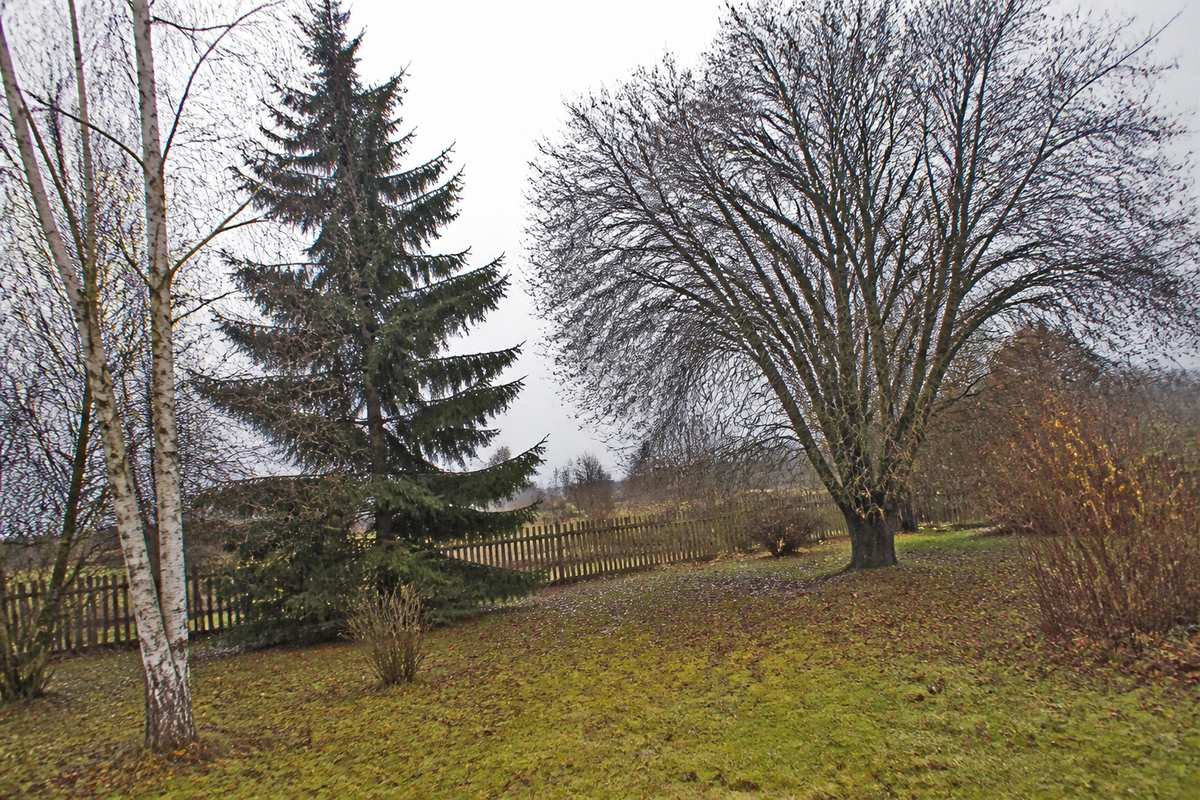
Ogre stretches along the Daugava and the Ogre river, and much of the town lies in pine forest on undulating ground. That creates two characteristic situations: houses standing in a conifer stand, and trees on slopes where access is not straightforward.
Pines and spruces in the town's housing
In the detached housing districts of Ogre many houses were built in a stand of pine and spruce, keeping the existing trees. It is handsome, but it also means the tree was suddenly exposed and its wind load changed.
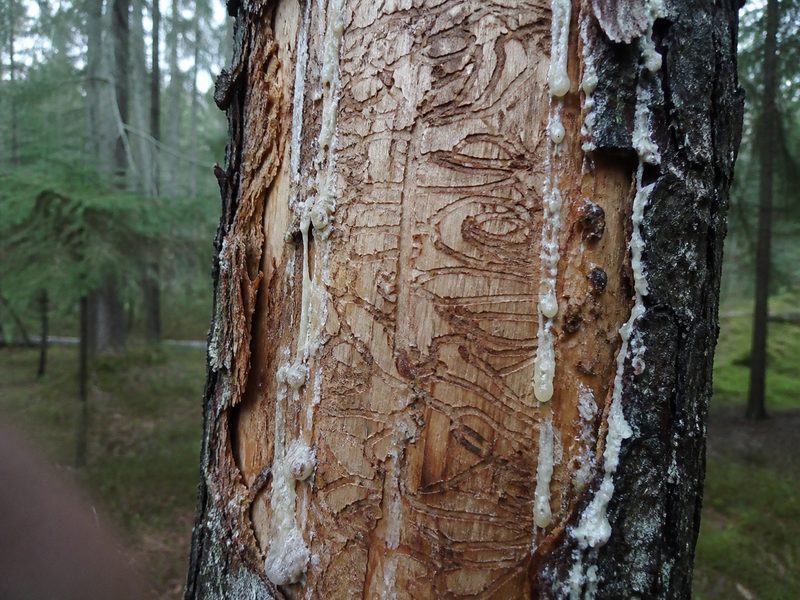
The spruce is the riskier here: a shallow root system, sensitivity to drought and — in recent years — the bark beetle. If you see brown boring dust at the base of a spruce, the bark beginning to come away in pieces, or the crown turning red-brown from the top down, the tree is usually beyond saving, and then timing is what matters most — a dead spruce quickly becomes brittle and dangerous to cut.
Slopes and river banks
On the banks of the Ogre river and the Daugava, and in the hillier part of the town, the trees grow on slopes. There the direction of fall is restricted, machinery often cannot get up, and a tree felled on a slope carries on moving after it lands.
So on sites like these we usually work with rope access, lowering the tree in sections, and carry the material out to a point where a trailer can be brought up. It is slower than felling on the level, but it is the only way not to damage the slope and its surroundings.
The town's linear structure
Ogre is long and cut through by the railway, the Daugava and the trunk road, so crossing between the northern and southern parts can take more time than it looks on the map.
For us that means just one practical thing: an exact address helps in your enquiry. From it we plan both the route and whether we can combine several jobs in the Ogre, Ikšķile and Ķegums direction in one visit.
Apartment districts and town trees
In the apartment part of Ogre the trees are the same age as the buildings and have now reached full size. The commonest enquiries: branches over the parking area and the footpath, dead tops, poplars at the gable end.
Work like this usually means deadwood removal or crown reduction rather than removing the tree. The client is the managing agent or the owners' community; we prepare the quote and the description of the work.
Sandy soil and shallow root systems
In most of Ogre's private housing districts there is sand beneath the turf. Water does not linger in it — after rain it drains away within hours, and the tree is left with whatever it managed to take up. Pines have adapted to that: they send a tap root deeper and at the same time hold a wide, very shallow network of roots in the surface layer, literally beneath the grass. It is precisely this surface layer that suffers most when a paved drive is laid under the tree, topsoil is spread for a lawn, or heavy machinery drives over it.
In practice that means two things. First, a tree that looks healthy from the outside can have been badly weakened for years before it becomes visible in the crown. Second, a shallow root system in sand holds trees less well than clay soil does — the wind takes them over with the whole root plate rather than breaking the trunk.
If you are planning building or landscaping work, the root zone is worth protecting before the work starts rather than rescuing afterwards — there is more on that under root protection during construction. If a tree already seems weakened, we start with a tree health assessment rather than reaching straight for the saw.
Gardens cut out of the forest
Many Ogre properties were created simply by building in the forest — the house put up among pines that were already growing, and the trees kept because they are beautiful. That is understandable, but there is an honest side to it too. In the forest a pine grows in dense company, with neighbours around it breaking the wind, and it grows tall with a high, small crown. When the surrounding trees are cut, the one left behind suddenly stands alone in the open — with a root system and trunk proportions formed for entirely different conditions. The first strong storms after clearing often take precisely these solitary survivors.
What we suggest weighing up if your garden was cut out of forest:
- Trunk proportions. A long, slender trunk with a crown only at the very top is a forest-grown tree — in the open it is risky.
- Groups rather than individual trees. Three or four pines together support one another better than one alone.
- Distance to the house and roof. We assess where the tree would land, not just how close it is.
- What the tree does with shade. Sometimes crown thinning is enough rather than felling.
We also say plainly if, in our view, the tree you are asking about is not worth keeping — and equally if it can be left for years yet.
What we do in Ogre
In Ogre we offer our full range of services — from a single dangerous tree to clearing an entire site. The most frequently requested:
- Dangerous tree removal — Dead, rotten, leaning and damaged trees. We assess first, then cut.
- Emergency tree removal — Fallen and broken trees after a storm — we come out the same day.
- Tree crown care — Crown shaping, thinning and deadwood removal.
- Stump grinding — Stump grinding without digging — the lawn stays almost untouched.
- Tree health assessment — Is the tree dangerous? We survey it and tell you what to do.
- Branch and timber removal — Removal of branches and timber, including where someone else did the cutting.
The full list with descriptions is in the services section.
How the work happens
- We get back to you within 5 minutes. Fill in the form and attach photos showing the tree at full height, its base and its surroundings. That is often enough for a rough quote.
- Assessment. We reply with an approximate price and method. In more complicated cases we come out to Ogre to look before the work.
- A permit, if one is needed. We check whether the Ogre local authority requires one for that particular tree, and we handle the paperwork for you.
- The work. We agree a time, arrive with everything needed and cordon off the working area.
- Clearing up. We chip or collect the branches and take them away. We don't leave wood chip in the garden. If you want the firewood, we cut it to length and stack it where you ask.
What the price depends on in Ogre
Two trees of the same height in Ogre can cost very differently — one stands in a level garden, the other on a slope above a neighbour's shed. The price is made up of the height and girth of the tree, the species, the condition, the distance to buildings, the drop zone, whether climbing or machinery is needed, and the volume to be taken away.
In Ogre the price is most often determined by the terrain and the access — a tree growing on a slope calls for rope work and carrying the material out, which costs more than the same tree with clear access. We have set out the full list with explanations on the prices page.