
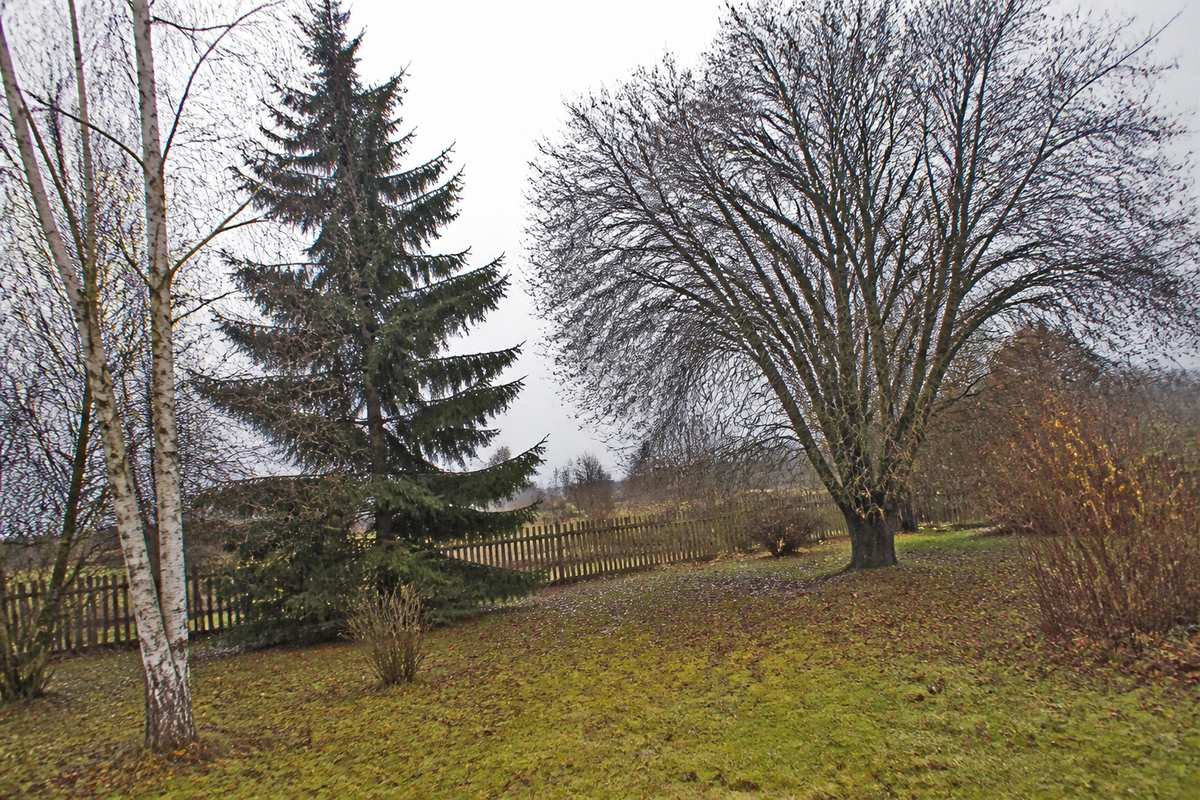
Iecava is a compact Zemgale town with a core of apartment blocks, districts of detached houses and production sites, around which the farmland begins. The boundary between town and country is close at hand, and you can see it in the trees: half the work is typically urban, the other half is farmstead and field work.
Wind load on the Zemgale plain
On the Zemgale plain trees grow without natural shelter. Trees standing alone by farmsteads, along roads and at field edges take the full wind load, and after storms it is here that we most often see trees thrown over with the whole root plate.
Two cases are the riskiest: a tree recently left exposed (a neighbouring row of trees cut or a building demolished), and a tree in wet ground after prolonged rain. If after a storm you see that a tree has begun to lean and the ground at its base has lifted, that is an urgent sign.
Farmsteads and old avenues
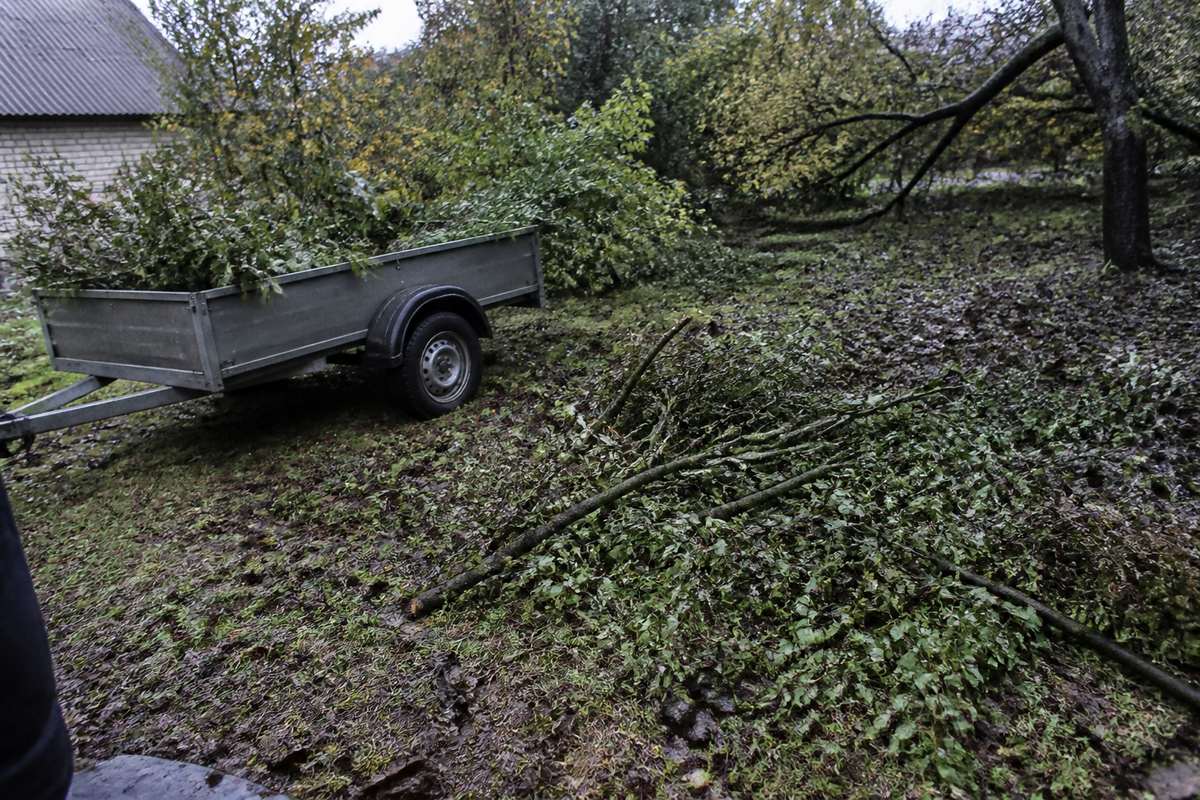
Around Iecava there are many farmsteads with old rows of limes and oaks planted generations ago. They are fully grown, and some already have dead tops, cavities or bracket fungi.
For groups of trees like these we almost never recommend full removal. The job is usually deadwood removal for the whole row and taking out the few that are genuinely dangerous. That costs less than felling the whole row and preserves the value of the property.
Access along the A7
The A7/Via Baltica gives a direct connection with Ķekava, Rīga and Bauska, so the journey to Iecava is predictable. Access to sites right on the trunk road, however, has to be planned separately — the transit traffic means machinery cannot be parked at the roadside without careful thought.
In such cases we plan the work during the day with appropriate cordoning, or we come in from inside the property where that is possible.
Tidying up plots
Around Iecava we often work on plots grown over with aspen, willow and young birch — usually before building work or a sale, or simply because the plot has gone untended for years.
We start by walking the plot with you and deciding what to keep. The rest we remove, chip and take away; the stumps can then be ground out. In more detail: clearing land of trees.
Old orchards at Iecava farmsteads
At almost every older homestead around Iecava there is a row of apple and plum trees behind the outbuildings, planted decades ago and unpruned in recent years. The crown has thickened, the fruit stays small, deadwood has collected in the middle, and strong water shoots grow from the stump or the graft. Often the owner has only just taken the house on and does not know where to start.
An orchard like that is not restored in one go. Cut half the crown off at once and the tree answers with an even thicker thicket of water shoots and grows weaker. We divide the work over two or three seasons: in the first we take out the dead, diseased and crossing branches and bring the height down as far as the tree will stand; in the following seasons we thin what remains and build a crown that lets the light through.
- Apples and pears we prune at the end of winter or in early spring, while the tree is still dormant;
- plums and cherries tolerate pruning better in early summer — less gumming and less risk of infection;
- if there is already a cavity or a bracket fungus in the trunk, we first assess whether the tree is worth restoring at all.
We write more about the approach under fruit tree pruning. We collect the cut branches and take them away — you do not have to burn them yourself.
Ash dieback in Iecava plantings and along the roadsides
Ash dieback is widespread in the ash stands and roadside plantings of Zemgale, and we see it often around Iecava: the top of the crown died back, the foliage thin, and sunken dark bark lesions appearing on the trunk and at the base of branches. The disease moves from the top downwards, and in many cases decay sets in at the root collar — the tree can then break or go over without warning even in a moderate wind.
The most dangerous part is that a dead ash becomes brittle quickly. The branches break when you climb on them, so we mostly cut dead ash from a MEWP or in sections with lowering rather than climbing into the crown. Where there is room in the open and nothing in the way, we fell it in one piece — that is simpler and cheaper.
If a whole row of ash stands along a drive or a pasture, there is no sense in cutting one a year. We survey the entire row and mark which trees are beyond saving, which need only deadwood removal, and which can be left under observation. We have also described the signs in the article on ash dieback.
What we do in Iecava
In Iecava we offer our full range of services — from a single dangerous tree to clearing an entire site. The most frequently requested:
- Dangerous tree removal — Dead, rotten, leaning and damaged trees. We assess first, then cut.
- Emergency tree removal — Fallen and broken trees after a storm — we come out the same day.
- Tree crown care — Crown shaping, thinning and deadwood removal.
- Stump grinding — Stump grinding without digging — the lawn stays almost untouched.
- Tree health assessment — Is the tree dangerous? We survey it and tell you what to do.
- Branch and timber removal — Removal of branches and timber, including where someone else did the cutting.
The full list with descriptions is in the services section.
How the work happens
- We get back to you within 5 minutes. Fill in the form and attach photos showing the tree at full height, its base and its surroundings. That is often enough for a rough quote.
- Assessment. We reply with an approximate price and method. In more complicated cases we come out to Iecava to look before the work.
- A permit, if one is needed. We check whether the Iecava local authority requires one for that particular tree, and we handle the paperwork for you.
- The work. We agree a time, arrive with everything needed and cordon off the working area.
- Clearing up. We chip or collect the branches and take them away. We don't leave wood chip in the garden. If you want the firewood, we cut it to length and stack it where you ask.
What the price depends on in Iecava
There is no flat rate per tree — trees of the same height can call for entirely different work. In Iecava the price is made up of the height and girth of the tree, its species and condition, the distance to buildings and cables, whether there is a drop zone, whether climbing or machinery is needed, and the volume of material to be taken away.
In Iecava the call-out is included in the price, so larger jobs or combining several sites in one visit give a noticeable saving here compared with one small job on its own. We have set out the full list with explanations on the prices page.