
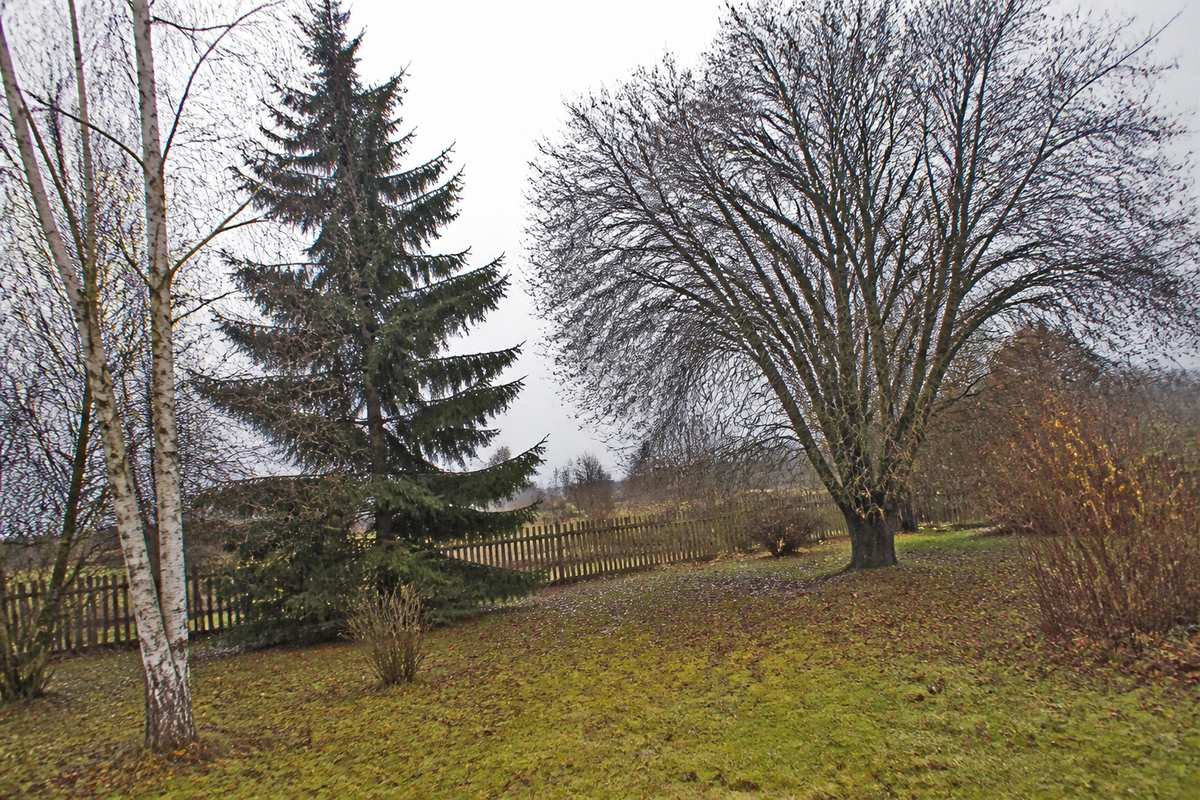
The spatial structure of Ķegums is set by the Daugava, the hydroelectric station, the railway and the A6. The built-up area is compact — detached houses, apartment buildings and technical sites — but forests and rural properties begin around it. That means one town holds both typically urban and typically rural tree work.
When a tree can be felled whole
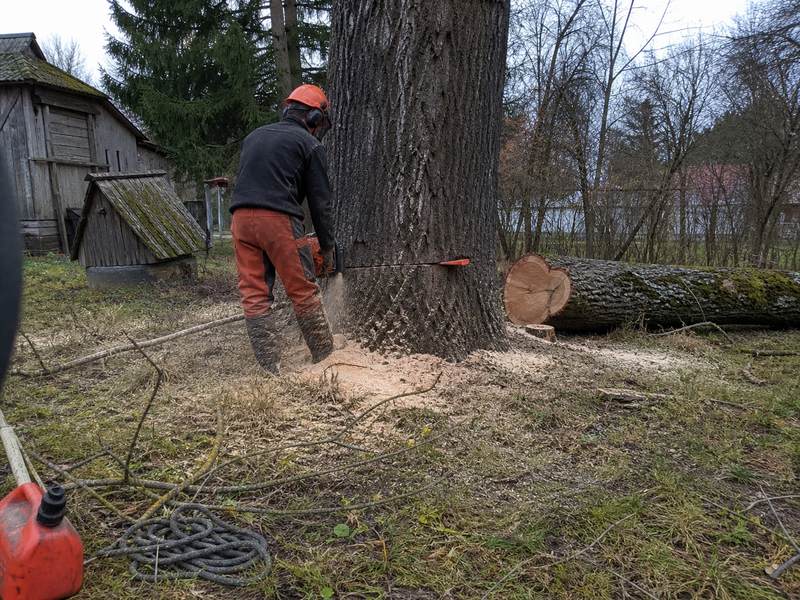
Unlike the inner courtyards of Rīga, in Ķegums there is quite often enough clear space around a tree. That is worth knowing, because felling a tree whole is the quickest and cheapest option — there is no climbing and no lowering of each section separately.
So when we assess a job we always look first at whether there is a drop zone. If there is, we say so and offer the cheapest solution. Sectional dismantling is not a better method; it is the method for cases where there is no other.
The Daugava and the reservoir nearby
On the banks of the Daugava and the hydro reservoir the soil is wetter, and the trees growing there — willows, aspens, grey alders, birches — grow fast and are brittle. After storms it is these trees that break and come down first.
In wet ground the roots also hold less well. If after a storm you notice that a tree has begun to lean and the ground at its base has lifted, that is not something to put off — it is the same sign that brings us out ahead of the queue.
Technical sites and infrastructure
Ķegums has energy and technical infrastructure sites, and their own access and safety rules apply around them. A tree growing by the fence of a technical site or by an overhead line is not an ordinary garden tree.
In such cases we first establish who owns the land and who may order the work, and whether coordination with the network operator is needed — in more detail: removal near power lines.
Wooded outskirts and rural properties
Around Ķegums there are wooded areas and rural properties where the commonest job is not a single tree but tidying the edge of a plot: an overgrown boundary, aspens and willows by the ditch, trees reaching over the access track.
For work like this we usually walk the plot with the owner and agree what to keep and what to remove. We chip the material and take it away or, if you prefer, cut it into firewood and stack it where you ask. In more detail: clearing land of trees.
What stays with you — firewood, cut lengths and wood chip
In Ķegums almost every private house has a woodshed or at least a stove, so the question of what becomes of the felled tree is usually one of the first. We settle it before the work rather than after the trunk is already on the ground — the answer determines how we fell the tree and where we stack the pieces as they come down.
If you want to keep the trunk, we cut it to the length you specify — most often 30, 40 or 50 cm — and stack it in the yard or by the shed. Splitting is not our job, but we can leave the firewood in a dry, properly stacked pile. With birch, ash and oak it is certainly worth it; with poplar, willow and grey alder we say honestly that the fuel value is low and it is often better simply to take it away.
- The thick lengths of trunk — cut to length and stacked at your place if you want to keep them.
- Branches and the top — either chipped or taken away.
- Wood chip — we can leave it in a heap on site as mulch for beds and paths; that is the cheapest option, as there is nothing to pay for removal.
We do not recommend rotten or fungus-damaged wood for firewood — how to recognise it is described in the section on bracket fungi on trees.
Old apple orchards and homestead fruit trees
Around Ķegums and in the nearest farmsteads the remains of Soviet-era apple orchards still stand in many places — trees planted forty or more years ago, unpruned for years and now tall, congested and full of deadwood. The apples grow at the top where they cannot be reached, while the lower branches die in the shade.
A tree like that cannot be rescued in one go. Take half the crown off in a single winter and the tree answers with a thicket of weakly attached shoots, and three years later the situation is worse than at the start. We work in stages: in the first season we take out the dead, crossing and inward-growing branches and lower the highest leader; in the second and third we gradually build an open crown that can be tended from a ladder. We prune in winter or early spring, before the sap rises.
Sometimes the more honest answer is different. If the trunk is hollow inside, the root collar soft, or most of the scaffold branches already dead, restoration is money wasted — better to fell the tree and plant a new one. What can and cannot be done we determine during the survey; we write more about the approach under fruit tree pruning.
What we do in Ķegums
In Ķegums we offer our full range of services — from a single dangerous tree to clearing an entire site. The most frequently requested:
- Dangerous tree removal — Dead, rotten, leaning and damaged trees. We assess first, then cut.
- Emergency tree removal — Fallen and broken trees after a storm — we come out the same day.
- Tree crown care — Crown shaping, thinning and deadwood removal.
- Stump grinding — Stump grinding without digging — the lawn stays almost untouched.
- Tree health assessment — Is the tree dangerous? We survey it and tell you what to do.
- Branch and timber removal — Removal of branches and timber, including where someone else did the cutting.
The full list with descriptions is in the services section.
How the work happens
- We get back to you within 5 minutes. Fill in the form and attach photos showing the tree at full height, its base and its surroundings. That is often enough for a rough quote.
- Assessment. We reply with an approximate price and method. In more complicated cases we come out to Ķegums to look before the work.
- A permit, if one is needed. We check whether the Ķegums local authority requires one for that particular tree, and we handle the paperwork for you.
- The work. We agree a time, arrive with everything needed and cordon off the working area.
- Clearing up. We chip or collect the branches and take them away. We don't leave wood chip in the garden. If you want the firewood, we cut it to length and stack it where you ask.
What the price depends on in Ķegums
The price is set by the conditions of the work, not by the size of the tree in itself. In Ķegums it is made up of the height and girth of the tree, its species and condition, the distance to buildings and cables, whether there is a clear drop zone, whether climbing or machinery is needed, and the volume of material to be taken away.
In Ķegums, if there is a clear drop zone around the tree and good access, the job costs considerably less than the same tree in a confined town courtyard — and we say so at the quotation stage. We have set out the full list with explanations on the prices page.